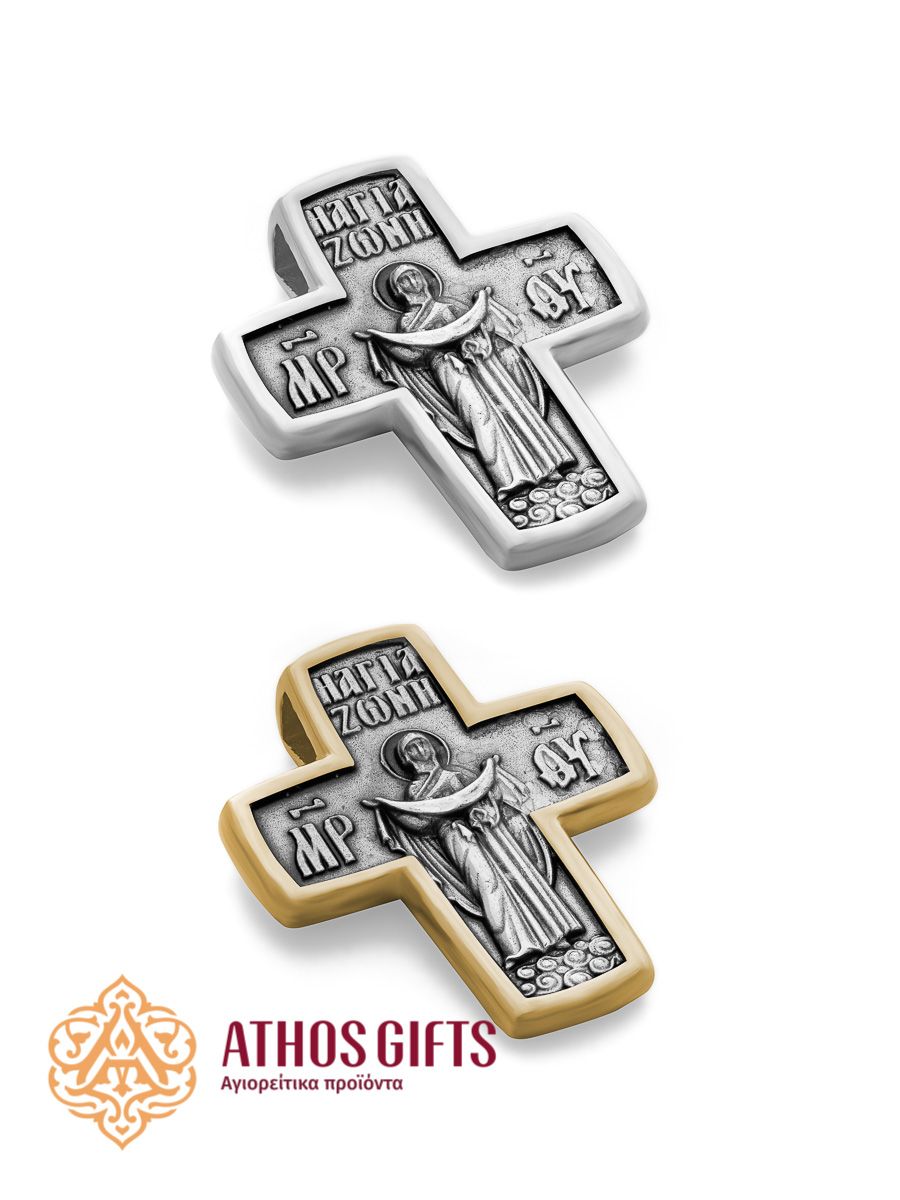
Sterling Silver Cross | Holy Mandilion and Holy Belt
SKU JI1126
125,00 €
Silver 925
Metal
Double-sided silver cross. The front side depicts the Holy Mandilion, with the image of the Holy Cincture on the reverse
In stock: 5 available
1
Save this product for later
Sterling Silver Cross | Holy Mandilion and Holy Belt
Product Details
This double-sided cross features the image of the Holy Mandilion on its front side. Around the image of the Savior stand saints Nicholas, Panteleimon and Spyridon.
On the reverse side, there is an icon of the Holy Cincture (Belt) of the Theotokos.
The piece is available in two variations: classic 925 sterling silver for lovers of simplicity, or gold-plated silver for those who prefer a warm glow. The compact size of the cross makes it perfect for everyday wear.
Characteristics
Dimensions: 3x2,5 cm
Material: 925 sterling silver (with or without gold plating)
Holy Mandilion
The Holy Mandilion (from Greek μανδύλιον "cloth, towel"), or the Image of Edessa, is one of the images not made by hands, through which Jesus Christ performed one of his many miracles:
In Edessa, in Mesopotamia, there once lived a king named Abgar, who suffered from an incurable disease, leprosy. His painter Ananias, who was traveling through Judea, heard about Christ and reported it to his master. The king gave the painter a letter to Jesus, asking Him to visit and heal him. Christ has declined king's invitation, but He did not refuse to help him. According to tradition, the Mandilion was a square or rectangle of cloth upon which Jesus Christ allowed His image to be imprinted and which He then sent to Abgar, after which Abgar was healed. The Mandilion has since been kept in Edessa as a great shrine.
Cincture of the Theotokos
The Cincture of the Theotokos has long been known to Orthodox Christians for its miracles: according to believers, it relieves women of infertility and gives the joy of motherhood. That is why many families without children offer prayers to the Mother of God before this shrine.
The relic has been preserved from the time of the Mother of God's earthly life. According to tradition, She herself wove this belt of camel hair, and after the Assumption, before Her transition to heaven, gave it to the Thomas the Apostle.
You May Also Like
Display prices in:EUR