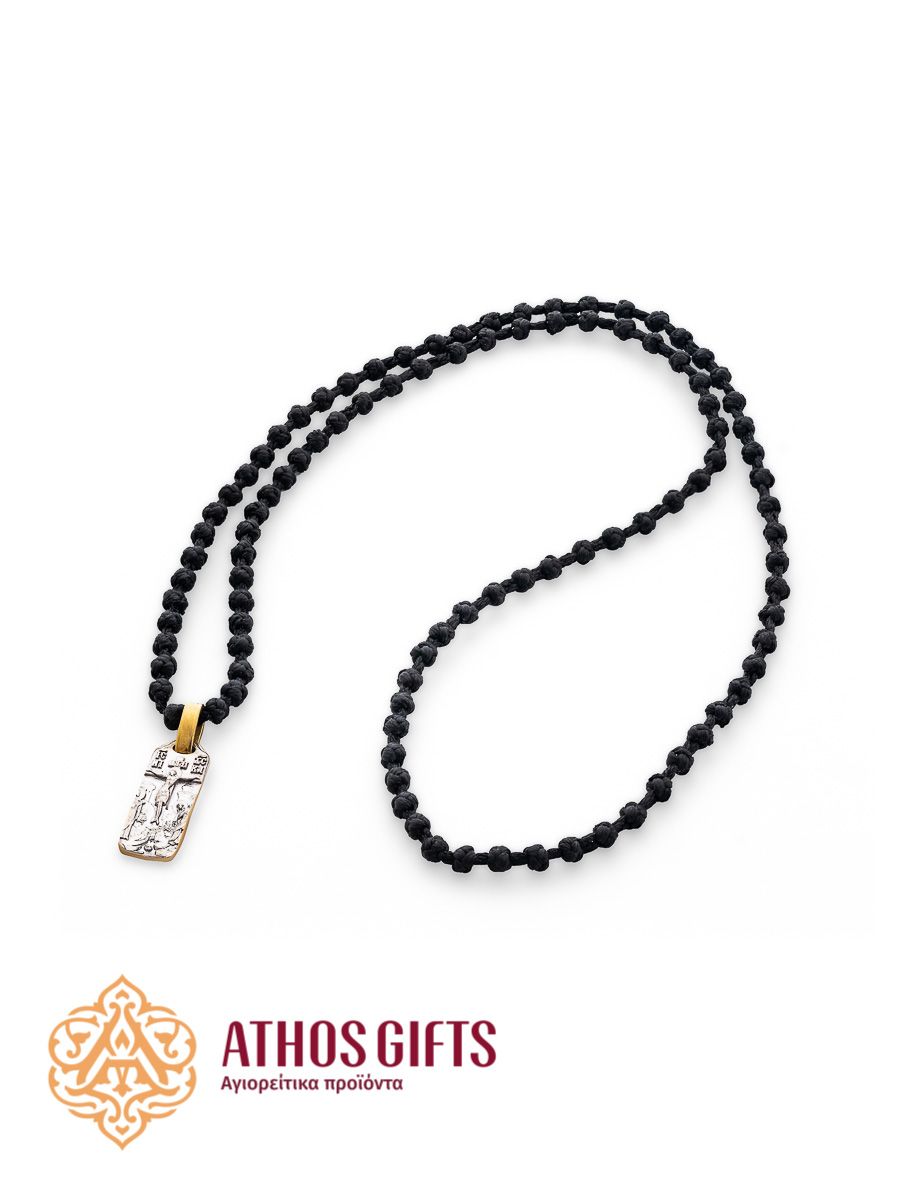
Prayer Rope with Silver Pendant | Crucifixion
SKU JI1111
60,00 €
Sold out
Braided prayer rope made of weaving cord with a 925 sterling silver pendant depicting the Crucifixion. Pendant size: 1x2,5 cm
Sold out
Save this product for later
Prayer Rope with Silver Pendant | Crucifixion
Product Details
The pendant is made of partially gold-plated 925 sterling silver. The front side depicts the Crucifixion of our Lord Jesus Christ surrounded by saints. At the top of the cross, there are inscriptions: ΙΣ ΧΣ ΝΙΚΑ ("Ἰησοῦς Χριστὸς νικᾷ"), which translates as "Jesus Christ Conquers", and ΙΝΒΙ ("Ἰησοῦς ὁ Ναζωραῖος ὁ Βασιλεὺς τῶν Ἰουδαίων"), translating as "Jesus, King of the Jews".
The reverse side features the "ΙΣ ΧΣ" hand gesture (right hand raised with fingers forming the monogram of the name of Jesus Christ), and the prayer: Κύριε Ιησού Χριστέ, ελέησόν με τον αμαρτωλό (Lord Jesus Christ, have mercy on me, a sinner).
Komboskini prayer rope
Greek komboskini prayer ropes are usually made of wool or special weaving cord. The name of the prayer rope reflects its essence and purpose: in Greek, kombos (κόμπος) means "knot", and skini (σχοινί) is a rope or cord.
Such prayer ropes are woven in a special way: each knot consists of 9 crosses of cord, symbolizing the nine crosses, or nine angelic ranks. Often seed beads are woven into the prayer ropes, and almost always they include crosses. The practical significance is that such dividers make it easier to count prayers. When a monk reaches the cross, he realizes that he has uttered a certain number of prayers.
Believers often decorate icons with komboskini prayer ropes, as well as give them to their family and friends to remember and pray for them.
Orthodox cross: history and symbolism
The Orthodox Church honors the Cross as a great relic symbolizing the redemption of the human race. The honorable Cross of the Lord for the Christian faith is the highest symbol of sacrifice and sanctification, and therefore its significance is truly invaluable. The Cross and the Resurrection are the two main axes of Christianity: the Resurrection follows the Cross and implies the Cross, and the Cross predicts the Resurrection.
Before Christ was crucified for our sins, anyone who died through crucifixion was considered damned. After Jesus died on the cross, it became a symbol of redemption. From an instrument of death the cross became an eternal source of life, from a horrible instrument of execution it turned into a light and blessed sign.
This paradox and great change came about because immeasurable divine love and mercy did not avenge human ignorance and evil. The all-redeeming divine love leaves no room for hatred, anger, and malice. God as absolute love, instead of vengeance, had mercy on mankind, giving redemption from the bitter bonds of sin and evil, giving mankind eternal life. After the crucifixion, the cross became associated with the Lord Jesus Christ, drawing from Him its invincible power, sanctification and grace. That is why the worship of Christians to the Cross is not idolatry; it is the worship of Christ Himself. Christians proudly wear the cross in memory of the great atoning sacrifice and as an effective bulwark against evil.
The honorable Cross of the Lord is the unifying force of mankind. The two crossbars of the Cross symbolize the union of men with God (the vertical crossbar) and the union of men with one another (the horizontal crossbar). The last one also symbolizes the two arms of the Crucified Savior, which are open to embrace all mankind.
You May Also Like
Display prices in:EUR